
New analysis finds HIV travel restrictions are shifting from border bans to hidden migration barriers as global progress stalls
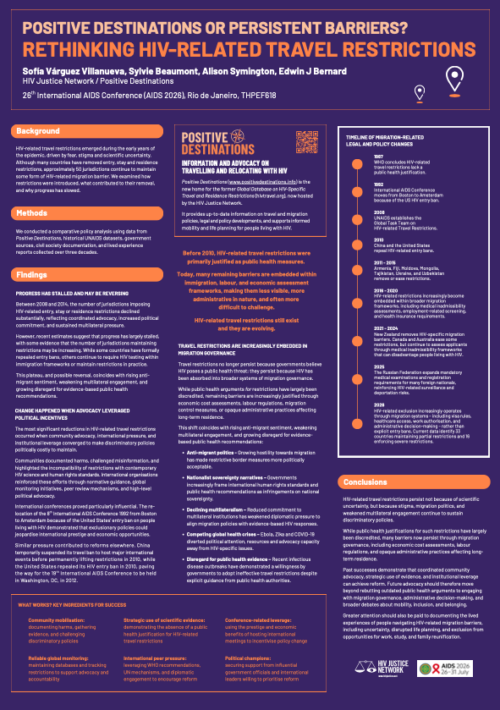
Research presented by the HIV Justice Network at AIDS 2026 reveals that HIV-related travel restrictions are no longer disappearing, but instead they are evolving. Updated global data show that 49 jurisdictions continue to impose HIV-related migration restrictions, with many now embedded in immigration systems rather than explicit entry bans, raising concerns that decades of progress may be stalling or even reversing.
Despite decades of advocacy and major victories in dismantling HIV-related travel restrictions, our latest analysis shows that discriminatory barriers continue to affect people living with HIV who wish to travel, work, study or settle abroad. Rather than relying on explicit HIV entry bans, many governments now embed HIV-related restrictions within broader immigration, labour and public administration systems, making them less visible, and often more difficult to challenge.
Our poster, Positive destinations or persistent barriers? Rethinking HIV-related travel restrictions, presented today at the 26th International AIDS Conference (AIDS 2026) in Rio de Janeiro, draws on three decades of data and lived-experience reports to examine how HIV-related migration restrictions have evolved and why progress has slowed.
The updated analysis identifies 33 countries maintaining partial HIV-related restrictions and a further 16 enforcing severe restrictions. While some countries have formally repealed HIV-specific entry bans, many continue to impose barriers through medical inadmissibility assessments, employment-related health screening, visa requirements, healthcare access rules and other administrative decision-making processes affecting long-term residence.
"The nature of HIV-related travel restrictions has fundamentally changed," said lead author Sofía Várguez Villanueva. "Governments rarely claim these measures protect public health anymore. Instead, HIV has become embedded within broader systems of migration governance, making discrimination less obvious but often much harder to identify and challenge."
Our analysis also traces the remarkable advocacy successes that led to the repeal of many HIV-related travel restrictions between 2008 and 2014. Coordinated community advocacy, political leadership and multilateral pressure helped persuade countries including China and the United States to remove their HIV entry bans. International AIDS Conferences also played an important role, most notably when the 1992 conference was moved from Boston to Amsterdam because of the US travel ban, demonstrating that discriminatory policies could carry significant political and economic consequences.
However, we conclude that this momentum has largely stalled. Recent developments – including expanded medical examination and registration requirements for many foreign nationals in the Russian Federation – illustrate how HIV-related restrictions are increasingly being reinforced through immigration systems rather than overt HIV-specific laws.
The research identifies several broader political trends driving this shift, including growing anti-migrant sentiment, increasing appeals to national sovereignty, weakening commitment to multilateral institutions, competing global health priorities following Ebola, Zika and COVID-19, and an increasing willingness by governments to ignore established public health evidence when designing border and migration policies.
The research draws on data from Positive Destinations, the HIV Justice Network's information and advocacy platform on travelling and relocating with HIV. Building on more than three decades of monitoring, the platform tracks legal and policy developments affecting the mobility of people living with HIV and provides practical information on travel and migration worldwide.
Our findings suggest that future advocacy must move beyond rebutting outdated public health arguments and engage more directly with migration governance, administrative decision-making and broader debates about mobility, inclusion and belonging. They also highlight the continuing need for robust monitoring of HIV-related travel restrictions to ensure discriminatory policies do not simply disappear from view as they become embedded within wider immigration systems.